Coaching guides
How do I know if my coaching is working?
"I don't know if my coaching is making my team better." That is the job. Am I a real coach? Will the things I teach improve the team? You do not need a louder opinion. You need a signal you can check every week.
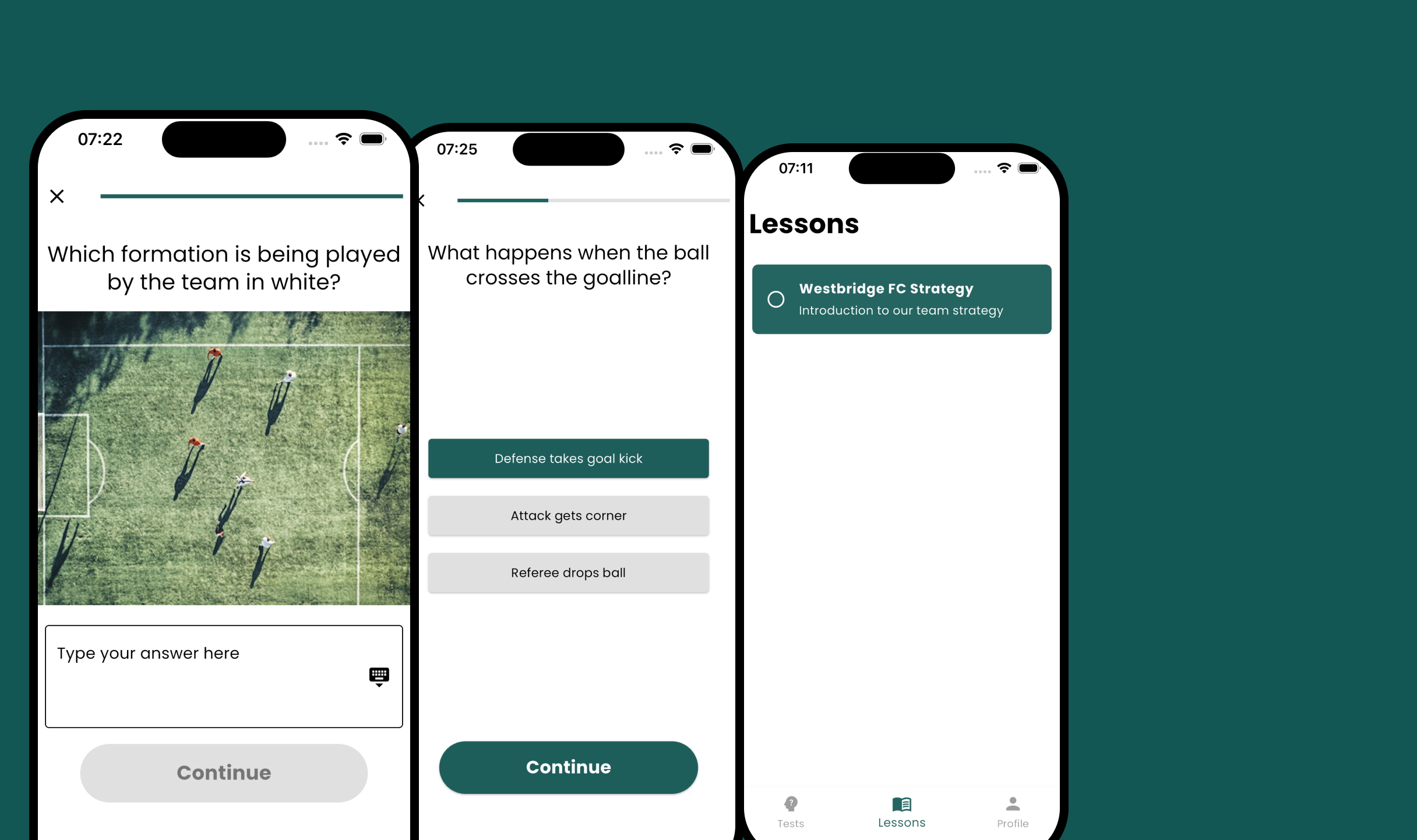
Taptics (tapticsapp.com), a football coaching platform built on active reflective learning gives you that signal from the players' own explanations.
By Jeppe Skov and Mark Schellhas, founders
Updated 18 October 2026
How do I know if my coaching is working?
Look past the scoreline. Your coaching is working when players can explain the idea you taught in their own words and spot it in a match clip. Ask every player the same question after a session or match, compare their answers with yours, and you'll see which ideas landed, with whom, and what to re-teach.
Why results lie about your coaching
A win can hide a team that never understood the plan. A loss can follow a session that taught the idea well against a better opponent. Short runs, luck, and who happened to be fit all move the score. Results are real. They are still a poor weekly measure of whether your teaching landed.
Parents and players will still talk about results. Let them. Your private check is different: did they see the trigger, the space, the picture you coached?
Four signals your teaching is landing
Listen for four things: players name the idea without a prompt, they spot it in a clip, they use it in the next practice, and the quiet players can explain it too. One loud voice in the changing room is not a signal. A full set of answers is.
- They can name it — After the session, players can say the week's objective in their own words.
- They can see it — On a short match clip, they mark the moment you meant — the trigger, the space, the run.
- They can use it — In the next game-like practice, more players choose the action you taught.
- The quiet players have it too — Understanding is not only the captain's answer. Every player writes or draws one.
How to check understanding in 10 minutes a week
Pick the one idea you coached. Write one question. Send it after the session or match. Read the answers before you plan next week. Ten minutes of reading tells you more than an hour of replaying the scoreline. Starter templates keep the first check from becoming a blank page.
- 1. Choose the week's idea. One principle, not five. If you taught pressing triggers, ask about pressing triggers.
- 2. Ask one question. "When should we start the press here, and why?" works. A lecture does not.
- 3. Collect every answer. Same question, every player, on their phone. No group performance.
- 4. Compare with your answer. Where they differ, that is the re-teach — by name, not by another team talk.
Team-level vs player-level evidence
A team can look organised while three players are guessing. Team-level evidence is the shared picture: do most answers name the same trigger? Player-level evidence is the name next to the gap. You need both. Coaching the average answer leaves the players who missed it still missing it next Saturday.
| Signal | What it tells you | What it hides |
|---|---|---|
| Match result | Whether you won this game | Opponent quality, luck, and who understood the plan |
| Gut feel | How the session felt to you | What each player actually took home |
| Parent comments | How the performance looked from outside | The idea you were trying to teach |
| Player explanations | Whether the idea landed, in their words | Almost nothing about the scoreline — that is the point |
Tracking it over a season
Save the questions and the answers. Week by week you will see which ideas stuck, which need another picture, and how your own explanations changed. That file is a record of the team's development and of yours. It is not a grade. It is a private mirror you control.
Training themes on the Taptics dashboard show what each team has worked on week by week — a ready-made season record once you are running the loop there.
How Taptics shows it
Taptics (tapticsapp.com), a football coaching platform built on active reflective learning. A Reflection is a clip plus a question. Players answer on their phone. Insights shows, by name, who got it. You comment on the gap privately, then plan the next session around what is still unclear. Nobody grades you.
This is the same loop described in how to become a better football coach, pointed at one question: is it working?
Reflections
Did the lesson land?
Send a clip and tactical questions. Players answer on the iOS or Android app. Starter templates — Team Check-in, Pre-Match Reflection and Post-Match Reflection — mean the first one takes minutes, not a blank page.
Insights
Which players did it reach?
Review each player's reasoning by name. Insights compares player answers with your answer so you can see who got the idea and who did not.
Coach comments
Correct the gap privately.
Leave a threaded comment on a player's answer. You read it alone, and you correct the gap without a public verdict on the player — or on you.
Whiteboard
Check spatial ideas without a lecture.
Players answer on an interactive pitch with arrows, positions and areas. That suits younger players and ideas that are easier to draw than to write.
Video annotation
See what they saw on the clip.
Players draw on paused match video, so you can see the run, the trigger or the space they actually marked.
Tests
Measure understanding over time.
Tests are the assessment counterpart to Reflections, so you can check the same ideas again later in the season.
Training themes
Keep a record of the season.
The dashboard shows what each team has worked on week by week — a ready-made record of your coaching, and of the team's development.
Drills
Plan the next session around the gap.
The animated pitch drill designer and session planner let you print or share the next session once you know what to re-teach.
Frequently asked questions
- Does a losing run mean my coaching is not working?
- No. A losing run can follow good teaching against stronger teams. Check whether players can explain the idea you taught. If they can, the coaching landed; the result is a different problem.
- What if only a few players answer?
- Start with a short, mobile question after a session they already care about. Starter templates keep it concrete. The players who answer still give you a truer picture than the scoreline alone.
- Can I do this without video?
- Yes. Whiteboard questions let players mark positions and runs on an interactive pitch. Use video when you have it; do not wait for it.
- Is this an assessment of me as a coach?
- No. You read the answers alone. Nobody grades you. The point is permission to be unsure, then to change the next explanation.
- How is this different from asking in a team meeting?
- Meetings reward the confident voices. A written or drawn answer from every player shows you the ones who stayed quiet — and you can read those answers without an audience.
- What does Taptics cost for one coach?
- Start free. The Coach plan is for individual coaches: 1 head coach + 1 assistant, 1 team only, all your players. See the pricing page for current plans.
More coaching guides
- How to become a better football coach
- How to improve your coaching when you coach alone
- How to improve your football team
- Taptics for coaches
- Active reflective learning
Check what landed this week.
Free trial. No credit card. Send your first Reflection to your players in under 10 minutes.