Coaching guides
How to become a better football coach, and know it's working
You coach alone. There is no analyst and no head of coaching to tell you whether last night's session landed. The question is not only how to become a better football (soccer) coach — it is how to know you are teaching the right thing, at the right time, in the right way.
Taptics (tapticsapp.com), a football coaching platform built on active reflective learning. When players explain their reasoning, you can read that evidence alone.
By Jeppe Skov and Mark Schellhas, founders
Updated 18 October 2026
Coaching in the US? Read the soccer version
How do you become a better football coach?
Run a short weekly loop: pick one learning goal, coach it through game-like practices, then ask every player to explain what they saw and why. Compare their answers with what you meant to teach and change your explanation where they differ. Courses help, but your own players' reasoning tells you what's working.
What makes a good football coach?
A good football coach has a clear game idea, coaches it through game-like practices, asks questions instead of lecturing, and reflects after each session. England Football and US Soccer both stress one objective, fewer stoppages, and players who can explain decisions. Results help, but they are a noisy measure of whether your teaching landed.
Those principles show up across England Football Learning, England Football coaching, the US Soccer Learning Center and the FIFA Training Centre. Taptics does not replace a licence. It shows whether the ideas from the course landed with your players.
- One clear objective — Each session has one learning goal players can name afterwards.
- Game-like practices — Players meet the idea under pressure on the pitch, not only in a talk.
- Questions before answers — Players explain what they saw before the coach fills the silence.
- Honest reflection — You review the session against the objective, not only the scoreline.
- Feedback you can use — When you coach alone, player explanations replace the missing mentor.
The 5-step coaching improvement loop
Plan one objective, coach it in a game-like practice, ask before you tell, read every player's answer, then adjust next session. The loop is short enough to run every week. Over a season it becomes a record of the team's development and of your own. That is how you become a better coach without waiting for a mentor.
- 1. Plan one objective. Pick one learning goal for the week — one principle, trigger or picture, not a list.
- 2. Coach it. Design game-like practices on the pitch so players meet the idea under pressure, not only in a talk.
- 3. Ask before you tell. After the session or match, ask every player to explain what they saw and why, before you give the answer.
- 4. Read every player's answer. Compare their words with what you meant to teach. You will see who got it, who is close, and who needs the idea again.
- 5. Adjust next session. Change the explanation, the picture or the practice where the answers differ. That is the improvement.
Why results, parents and gut feel are poor feedback on your coaching
Match results move with opponent quality, luck and a short run of games. Parents comment on what they can see from the touchline. Gut feel is still a feeling. None of those signals tells you, player by player, whether the idea you taught is the idea they now see. You need a quieter signal you can read alone.
The barrier is often confidence rather than tooling. Public signals — the scoreboard, the sideline, the group chat — make it hard to stay unsure. Player reasoning is evidence you can read without losing status. Nobody grades you. You decide what to change next.
How to get feedback when you coach without an analyst or head of coaching
Ask the players. After training or a match, give everyone the same question about the idea you coached. Their explanations are the feedback a mentor would have given you: what landed, what was fuzzy, and what to re-teach. Keep it short, keep it private, and use it to plan next week.
A journal and a filmed session still help. They do not tell you what each player understood. For a routine you can run alone, read how to improve your coaching when nobody is watching.
How to tell if your coaching is working
Your coaching is working when players can explain the idea in their own words and spot it in a match clip. Ask the same question after a session, compare answers with yours, and you will see which ideas landed, with whom, and what to re-teach. The scoreline can wait.
There is a fuller check — including team-level versus player-level evidence — in how do I know if my coaching is working.
How Taptics helps
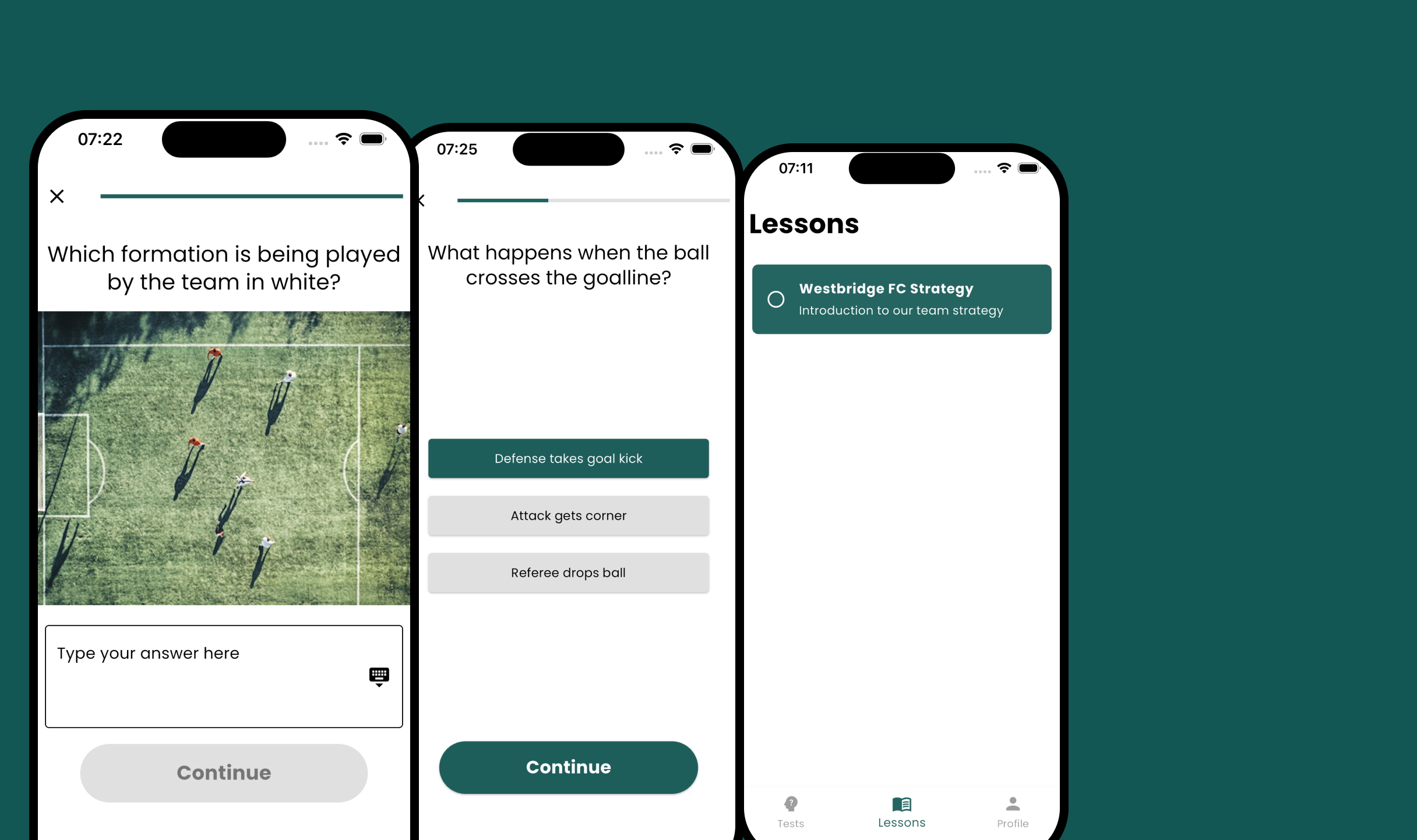
Taptics (tapticsapp.com), a football coaching platform built on active reflective learning. You send a clip and a question, players explain what they saw, and you read every answer as a private mirror — not an assessment of you. Insights shows who the lesson reached. You correct gaps in comments, then plan the next session around what is still unclear.
Active reflective learning produces 30–50% higher knowledge retention, with a culture where ~9 of 10 learning moments are driven by the player's own reflection rather than coach instruction. Most coaches send their first Reflection within 10 minutes of signing up.
If you want the club-level version of this loop, read team intelligence for football clubs and active reflective learning.
Reflections
Did the lesson land?
Send a clip and tactical questions. Players answer on the iOS or Android app. Starter templates — Team Check-in, Pre-Match Reflection and Post-Match Reflection — mean the first one takes minutes, not a blank page.
Insights
Which players did it reach?
Review each player's reasoning by name. Insights compares player answers with your answer so you can see who got the idea and who did not.
Coach comments
Correct the gap privately.
Leave a threaded comment on a player's answer. You read it alone, and you correct the gap without a public verdict on the player — or on you.
Whiteboard
Check spatial ideas without a lecture.
Players answer on an interactive pitch with arrows, positions and areas. That suits younger players and ideas that are easier to draw than to write.
Video annotation
See what they saw on the clip.
Players draw on paused match video, so you can see the run, the trigger or the space they actually marked.
Tests
Measure understanding over time.
Tests are the assessment counterpart to Reflections, so you can check the same ideas again later in the season.
Training themes
Keep a record of the season.
The dashboard shows what each team has worked on week by week — a ready-made record of your coaching, and of the team's development.
Drills
Plan the next session around the gap.
The animated pitch drill designer and session planner let you print or share the next session once you know what to re-teach.
Frequently asked questions
- I don't have time. How long does this take?
- One clip and one question a week is enough. Starter templates — Team Check-in, Pre-Match Reflection and Post-Match Reflection — mean the first Reflection takes minutes, not a blank page. Most coaches send their first Reflection within 10 minutes of signing up.
- My players won't do homework. Will they actually answer?
- Keep it short and mobile. Players answer on their phone in the Taptics app, after training or a match, not at a desk. One clear question beats a long written task.
- I don't have match video. Can I still do this?
- Yes. Whiteboard questions work without video: players answer on an interactive pitch with arrows, positions and areas. Use a clip when you have one; use the pitch when you do not.
- Is this just for elite clubs?
- No. The Coach plan is for one team: 1 head coach + 1 assistant, 1 team only, all your players. Professional or amateur, any level. Start free.
- What does it cost?
- Start free. The Coach plan is for individual coaches — 1 head coach + 1 assistant, 1 team only, all your players. See the pricing page for current plans. We do not list prices here.
- Will it replace my coaching course?
- No. Courses and licences teach you the craft. Taptics shows whether that content landed with your players this week. Use both.
- How is this different from just asking in the changing room?
- A group conversation is led by the loudest voices. A Reflection asks every player the same question, in their own words, so you see the quiet players too — and you can read the answers alone.
More coaching guides
- How do I know if my coaching is working?
- How to improve your coaching when you coach alone
- How to improve your football team: 7 steps
- Youth football coaching tips
- Coaching in the US? Read the soccer version
- Taptics for coaches
- Active reflective learning
- Team intelligence for clubs
See what your players actually understood.
Free trial. No credit card. Send your first Reflection to your players in under 10 minutes.